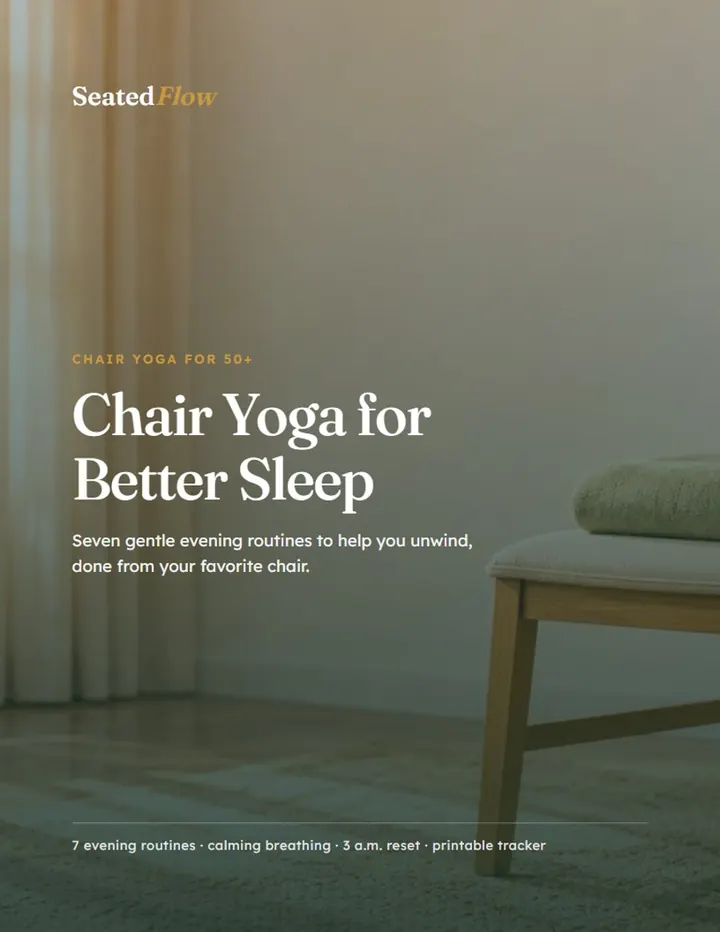
What is Steady on Your Feet?
Steady on Your Feet is a SeatedFlow PDF that turns balance practice into a short 14-day plan. Its idea is that balance is a skill that responds to gentle, regular practice. You start seated, build leg strength, then add simple standing balance work, always with both or one hand on the back of a sturdy chair.
The topic matters. About one in four adults aged 65 and older report a fall each year, according to the CDC. The CDC also lists balance activities like walking heel-to-toe and standing from a sitting position as part of recommended weekly activity for older adults (CDC guidance). Both of those moves are in this plan.
What is inside (25 pages)
| Section | What you get |
|---|---|
| Welcome & how the 14 days work | The three phases and how to pace yourself. |
| Safety page | Doctor check, chair and floor set-up, footwear (grip shoes or barefoot, never socks on a smooth floor), have someone nearby at first. |
| Move Library | 16 moves with steps, Easier/More options and tips. |
| 14 daily routines | One page per day with the moves, reps and minutes. |
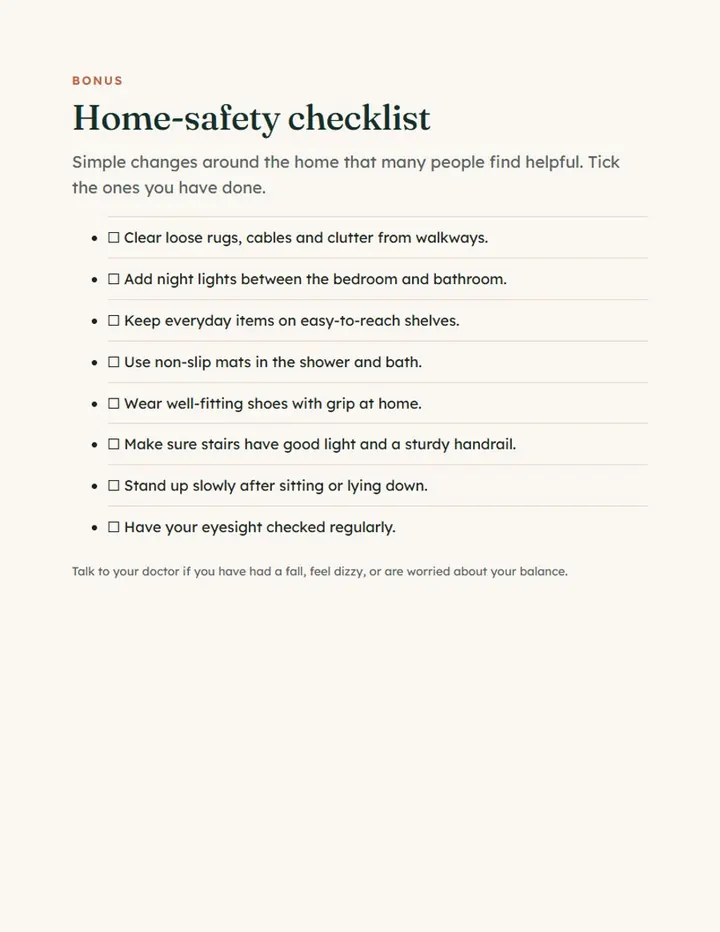
| Home-safety checklist | Eight simple changes around the house. |
| 14-day tracker | Tick off each day. |

How the 14 days progress
| Days | Phase | Daily themes |
|---|---|---|
| 1–4 | Seated: wake up feet and legs | Wake Up Your Feet · Strong Seat · Quick Feet · Up & Down |
| 5–9 | Standing with the chair: weight shifts and steadiness | Meet Standing · Sway Like a Tree · Week 1 Review · Side Strength · Steady Stance |
| 10–14 | Longer holds and gentle reaching | One Foot at a Time · Reach Around · Strong & Steady · Confident Flow · Your Balance Routine |
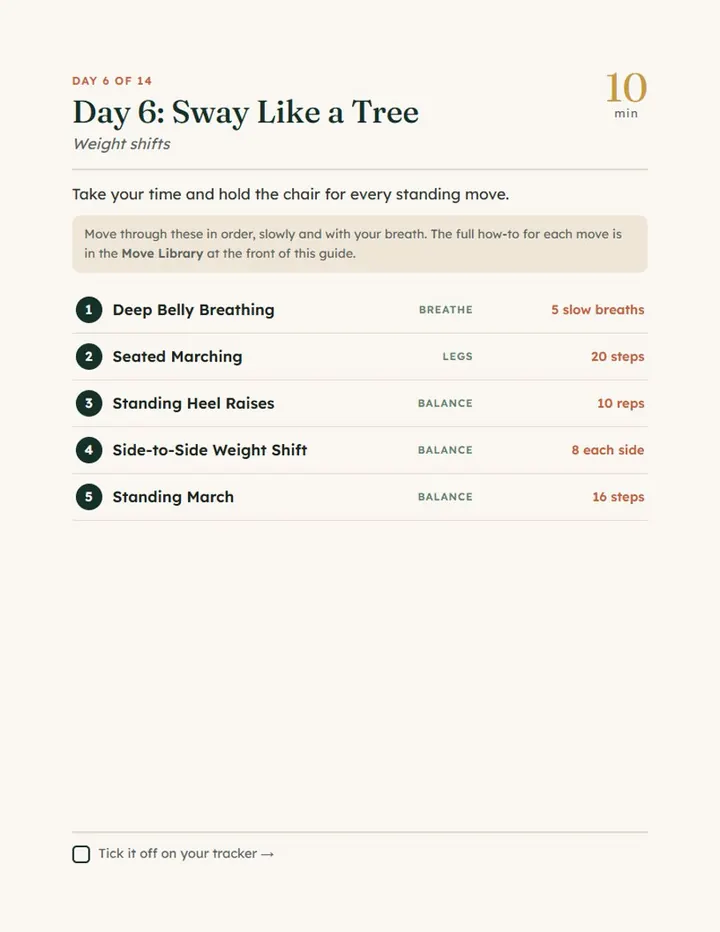
Day 6 shows the level: about 10 minutes of Deep Belly Breathing, Seated Marching, Standing Heel Raises (10 reps), Side-to-Side Weight Shift (8 each side) and Standing March (16 steps), all holding the chair.
The 16 moves
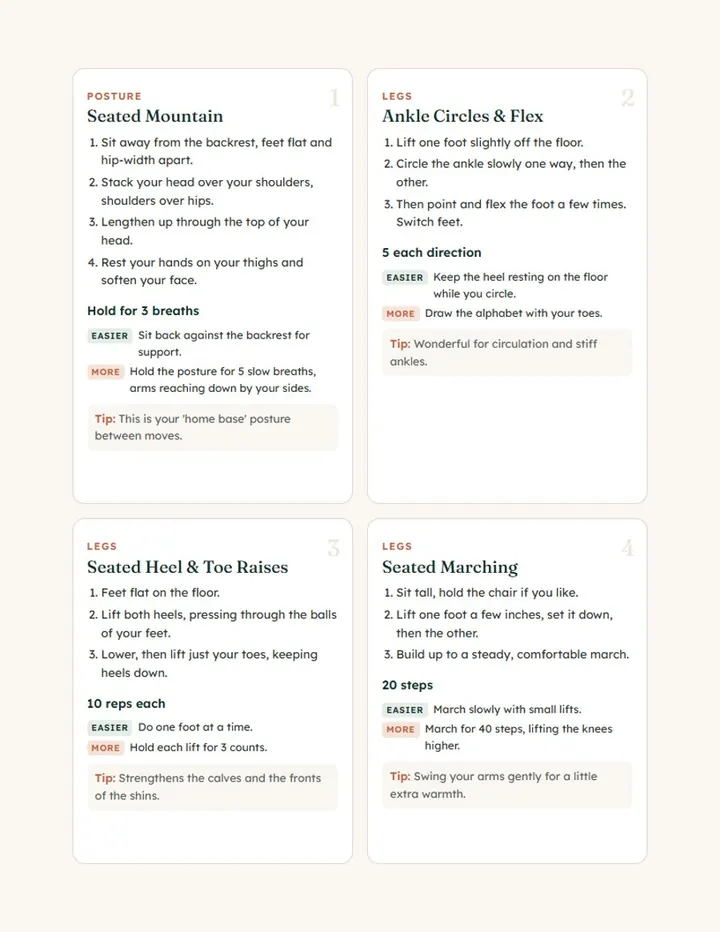
- Seated foundations: Seated Mountain, Ankle Circles & Flex, Seated Heel & Toe Raises, Seated Marching, Quick-Step Seated March, Seated Leg Extensions, Deep Belly Breathing.
- Strength: Sit-to-Stand.
- Standing balance, holding the chair: Standing Heel Raises, Side-to-Side Weight Shift, Standing Side Leg Lift, Standing March, Heel-to-Toe Stand, One-Leg Stand with Chair, Clock Reach, Standing Hip Extension.
The Quick-Step Seated March is a nice touch. The guide explains that quick feet help you react faster if you trip, and you practise it safely sitting down. Sit-to-Stand ("nose over toes") is probably the single most useful everyday-strength move in the plan, with an easier version that lets you push off with both hands.
Safety: what it gets right
- Every standing move is done holding the back of a sturdy chair. If you feel unsteady, you sit down.
- Footwear advice: shoes with grip or barefoot, never socks on a smooth floor.
- Check with your doctor first if you have a health condition, recent surgery, dizziness, or have had a fall.
- Have someone nearby the first few times if you have fallen before or feel nervous.
Pros and cons
Pros
- Sensible progression: seated first, standing later
- Always chair-supported when standing
- Practises moves the CDC lists as balance activities
- The home-safety checklist is genuinely useful
- Short days (about 10 minutes), low price
Cons
- Only 14 days: you need to keep practising afterwards
- No video or personal assessment
- Not suitable if you cannot stand with support
- Not a replacement for physical therapy after falls
Who it is for
- Adults over 50 who feel a little wobbly on stairs, curbs or when turning.
- People who want to build confidence before trying a class.
- Adult children looking for a safe, simple plan to share with a parent (ideally doing the first sessions together).
If stiffness and general fitness are your bigger concern, start with the 28-Day program, which includes a balance week. If evenings are the problem, see Chair Yoga for Better Sleep.
Price and value
It costs $11.99 once, with an instant PDF download and a 30-day money-back promise from the seller (official product page). For a clear, safety-first two-week plan plus a home checklist, that is a fair price.
Questions people ask before buying
Is Steady on Your Feet safe if I have fallen before?
The guide says to check with your doctor first if you have had a fall, and to have someone nearby the first few times if you have fallen before or feel nervous. A physical therapist can also assess your balance. Every standing move in the plan is done holding a sturdy chair.
Will it prevent falls?
No product can promise that. The CDC lists balance activities such as heel-to-toe walking and standing up from a chair as part of recommended activity for older adults, and this plan practises exactly those kinds of moves. Falls have many causes, including medicines, vision and home hazards, so talk to your doctor about your risk.
How long is each day?
About 10 minutes for most days.
Do I have to stand?
Days 1–4 are seated. Standing starts on Day 5, always holding the back of a chair. If you cannot stand safely, the 28-Day program's seated weeks are a better place to start.
What is the home-safety checklist?
A one-page list of simple changes, such as clearing rugs and cables from walkways, adding night lights between the bedroom and bathroom, non-slip mats in the shower, good stair lighting with a sturdy handrail, standing up slowly, and having your eyesight checked.
What happens after 14 days?
Day 14 is "Your Balance Routine", a routine designed to keep. You can repeat the plan or keep doing Day 14 a few times a week.
Is there a refund?
The seller offers a 30-day money-back promise. Check the current terms on the SeatedFlow store.
Our verdict
Steady on Your Feet is a careful, chair-supported introduction to balance practice. It starts seated, keeps a hand on the chair for every standing move, and includes a useful home-safety checklist. It cannot assess you the way a professional can, so see your doctor first if you have had falls. For anyone who simply feels less steady and wants a safe daily plan, it is a good, low-cost start.
Get Steady on Your Feet for $11.99Secure checkout on the official SeatedFlow store. One-time payment · instant PDF download · 30-day money-back promise from the seller.